A Time to Build: Lessons from Nehemiah-Taking Time to Give Thanks
Taking Time to Give Thanks

Summary: In Nehemiah 11, we come across a situation where the people are faced with a national referendum. They didn't believe in “luck” or “chance.” They actually were so committed to the sovereignty of God that they knew God would direct the outcome of the lot
Series: A Time to Build: Lessons from Nehemiah
Scripture: Nehemiah 11:1-11:47
Date: 20, November 2016.
Introduction
You
made a good decision this morning to come to church because I have
some inside information about the recent USA presidential election
that you will not hear on CNN. With all the intrigue and controversy
surrounding the final tally, coupled with the waiting that we've had
to do as believers, I wanted to fill you in on what really
happened this past Tuesday.
The
election, contrary to what the experts have been telling us, This wasn't a squeaker, this wasn't even close. It was a blowout.
That’s a whole lot of deplorables. The voiceless had their day.
Today, America is great again. It was a landslide and there will be no recount in a tightly contested race between a cat and a dog, the cat won by a certified margin of 6 to 2! Washington Post eats the bite:
Donald Trump is the president-elect of the United States of America, and he did it by completely blowing up the electoral map and all of our projections and expectations of it.To wit:
- Trump won his “must-win” states of Ohio, Florida and North Carolina in races that were called on Tuesday night.
- He won his other apparent “must-win” state, blue-leaning swing state Pennsylvania, which was called for Trump early Wednesday morning.
- Not stopping there, he won two states in which he didn't even campaign until the final week of the 2016 election: Michigan and Wisconsin. These, like Pennsylvania, are states that have long eluded the GOP’s grasp and didn't seem likely to be winnable for Trump.
All of this disproves the idea, which we and everyone else have espoused early and often, that Trump’s path to victory was narrow. It wasn’t. It was broad. We were wrong. The polls were wrong. We fundamentally misunderstood this election. We thought Hillary Clinton might be winning red states. But Donald Trump won blue states.
It was looking like he had to win Florida, Ohio and probably both Pennsylvania and North Carolina. He won all four, but he didn’t even need to. Trump’s win in Wisconsin and apparent victory in Michigan (where he leads but the AP hasn't made a call) are just the icing on the cake at this point. It looks like the electoral college won’t even be close.
I
read something sixteen years ago from Chuck Colson, then President of Prison
Fellowship that helps us keep any election in
perspective. I want to share part of it with you:
“Whichever way things turn out, some people will be joyous, and some people will be dismayed. But one thing is absolutely clear. It should not alter in the slightest the course that we, as Christians, follow in our society…If you’re disappointed in the election results when they’re finally clear, that’s understandable. All of us have partisan choices. Maybe you’ll be jubilant over them. If so, you’re going to think, ‘Well, the culture war’s been won.’ And if you’re discouraged over the results, you’ll think, ‘The culture war’s been lost.’ Nonsense!
Cultures are changed from the bottom up. Fads start from the top down. Movements start from the bottom up… what moves America are the ‘habits of the heart.’ This is the genius of America. We are moved by the tastes and dispositions of the people. We’re moved by the way we live with our neighbors around us. People need to see something better, something that they can long for in our lives. That isn't affected by elections. They’re not going to look to Washington for that, they’re going to look to us.
So we keep living in biblical faithfulness. And remember, too, that God appoints the leaders. And that whatever happens in the election that’s now being tallied; we have to accept God’s sovereign judgment. We have to pray for those in authority. We have to respect those whom God has put in power over us, and live peaceably in the midst of whatever government we have. The first century church did that; the twenty-first century church ought to be doing exactly the same thing. Don’t be overly jubilant, but don’t despair. Take a cool-headed perspective and keep your Christian faith and your Christian witness strong.”
(Break Point with Charles Colson,
11/8/2000)
Colson
is saying that we need to keep the main thing the main thing. We need
to focus on the most important. As we near the end of the Book of
Nehemiah, we’re discovering what really matters. As someone has
said, “God is large and in charge.”
When
an election is this close, it shows the value of everyone’s vote.
When there are only a few votes separating the candidates, some have
suggested that we should just flip a coin or have them draw straws.
I’m not sure this would be the best way to elect a president today,
especially when there’s such a difference between their
personalities, their platforms and their positions.
In Nehemiah
11,
we come across a situation where the people are faced with a national
referendum. But instead of taking a vote, they flip a coin to
determine what should be done. Actually, the biblical phrase is that
they “cast lots.” In the Old Testament, the casting of lots was
like throwing dice and was a way of discovering God’s will. We even
see this used in the Book of Acts when the disciples are trying to
figure out who should replace Judas in Acts
1:26:
“Then they cast lots, and the lot fell to Matthias; so he was added
to the eleven apostles.”
They didn't believe in “luck” or “chance.” They actually were so
committed to the sovereignty of God that they knew God would direct
the outcome of the lots according to His divine providence. Proverbs
16:33 says,
“The lot is cast into the lap, but its every decision is from the
Lord.” The votes are cast by the people but the election is
determined by the Lord.
Since
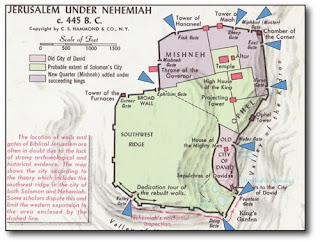
the walls and gates of Jerusalem were now restored, it was important
that the builders inhabit their capital city and make the population
grow. Some of the citizens volunteered willingly while others had to
be “drafted.” We see this in verse 1: “Now the leaders of the
people settled in Jerusalem, and the rest of the people cast lots to
bring one out of every ten to live in Jerusalem, the holy city, while
the remaining nine were to stay in their own towns.” The people had
promised to tithe their produce and income in chapter 10; now
Nehemiah decides to tithe the people by arranging for 10% of them to
move from the suburbs to the city.
These
believers exhibited four counter-cultural traits that have
application to us today. Regardless of who is the president, this is
how God wants us to live.
Sermon
4 Traits to Emulate
1. Move out of your comfort zone.
Most of the families living outside
Jerusalem depended entirely on the land for their daily existence.
Over the years they had developed a pattern of life as they plowed,
planted and harvested their crops. For many of them, the thought of
leaving their comfort zone was highly traumatic. But some left their
homes, relatives, neighbors, work, friends, and familiar
routines to set up a new life in a radically different environment.
Are
you willing to leave your comfort zone for the sake of the kingdom? I
don’t know what God might be asking you to do, but I do know that
He wants you to be available. I’ll never forget what God did about
five years ago, as a result of a prayer I prayed: “Lord, I’m
willing to do whatever you want, to go wherever you want, whenever
you want it.” It was shortly after this that God moved me out of
our comfortable routine in Hindupur, AP to the heart of Bengaluru City.
What
is God asking you to do that may stretch you? Maybe you need to check
out a short-term missions trip. As you pray for your neighbors, and
look for ways to care for them, God wants to use you to share with
them. For many of us, that’s outside our comfort zone. Maybe it’s
as simple as putting the “Jesus is Coming” sign on your front
lawn. Or it might be a commitment to start tithing. Whatever it is,
tell God you’re willing to live outside your normal boundaries. Let
him stretch you.
2. Commit to holiness.
After moving out of their comfort zone, the
believers commit to holy living. They didn’t just agree to live in
a remodeled city; they were coming to “the holy city.” Nehemiah
was fascinated by the holy and has reminded us that the Sabbath is a
distinctive day (10:31) and that the temple sacrifices are sanctified
(10:33). His ministry partner, Ezra, emphasized that God’s people
need to be holy (Ezra
9:2).
Jerusalem itself was set apart for the Lord’s special use. To live
in Jerusalem and be given the opportunity to serve God in such a holy
place was an immense privilege. This would outweigh their natural
sense of disappointment about leaving their friends and families.
To
live in the holy city might be a great privilege, but it was also a
challenging responsibility. It’s one thing to have a home in a holy
city; it’s another thing to make a home holy. Living in a holy
context did not automatically transmit holiness to the individual
citizens they were made holy be giving everything over to God.
Have you committed yourself to holiness and purity? Are you living
your life separated from the “world” because you’re set apart
for His use?
3. Mobilize for ministry.
Now that the people were committed to live
outside their comfort zone and wholeheartedly devoted to holy living,
they are now ready to be mobilized for ministry. We’ve already seen
that some people were drafted to live in Jerusalem. But there were
others who offered themselves freely to this new work in verse 2:
“The people commended all the men who volunteered to live in
Jerusalem.”
In
the remainder of chapter 11, we see that God has always used a wide
variety of people. I see three different groups in this passage:
Those
with leadership gifts. In addition to the leaders mentioned in verse
1, there were “provincial leaders” mentioned in verse 3. These
pacesetters were noble examples to those who were relocating to
Jerusalem. If the leaders are out front, then others will follow.
Someone has said, ‘The speed of the leader determines the speed of
the team.” This is true. As the leaders of TPHIM commit their time,
talents and treasures to kingdom living and kingdom expansion, the
environment is set for others to follow that example.
Those
with administrative gifts. As you read this long list of names in
chapter 11, there were other people who served as administrators.
Verse 9: “Joel son of Zicri was the chief officer, and Judah…was
over the Second District.” These officers made sure the city
functioned well and that the infrastructure was sufficient to handle
the growing population.
Those
with serving gifts. Verse 16 tells us that two guys “had charge of
the outside work of the house of God.” The temple had to be kept in
good repair and these individuals dedicated their practical skills to
care for the building. We have been blessed with deacons at TPHIM who
serve with both their hearts and their hands. Thanks, guys for your
commitment to this part of the ministry. Actually, this church is
filled with people who use their serving gifts on a regular basis.
You are appreciated!
Friend,
are you mobilized for ministry? As Romans
12, Ephesians 5.14 and 1
Corinthians 12 make
clear, every believer has at least one spiritual gift that has been
given to be used. We are saved to serve. As I like to say: No one can
do everything, but everyone can do something. Let me encourage you to
find your ministry niche and discover the joy of serving in your area
of giftedness.
4. Adore God in worship.
Take a look at 11:17 where we see that Mattaniah was the “director who led in thanksgiving and prayer.” In thanksgiving we acknowledge God’s generosity. In prayer we seek God’s help. These themes were often expressed in song as we see in verse 22: “Uzzi was one of Asaph’s descendants, who were the singers responsible for the service of the house of God.”
David
had commissioned his worship leader Asaph in a similar way centuries
earlier in 1
Chronicles 16:8:
“Give thanks to the Lord, call on His name.” Praise and prayer
are central to the spiritual life of God’s people. That’s what
we’ll be doing this. We’ll praise God in song as we adore Him, as
we confess our sins, as we thank Him, and as we intercede on behalf
of our community. I hope you can come.
Guidelines for Worship
Worship
can be defined as “worth-ship,” where we engage our mind, our
emotions, and our will to gratefully acknowledge the worth of our
God. There is no other human activity as lofty as that of adoring
God. As important as electing a PM is to our country, the
determination to worship God is supreme. Like Colson said, “we must
keep living in biblical faithfulness.” The Westminster Shorter
Catechism states “our chief end is to glorify God and enjoy Him
forever.”
If we've been made to magnify the Majesty, then we need to know how to
do that.
Nehemiah
12 begins
with a long list of names. Verse 24 helps us see that there were two
choirs who stood opposite from each other to “give praise and
thanksgiving.” I want to spend our remaining moments gleaning
4 worship guidelines from verses 27-47.
1. The Purpose of Worship.
Let’s start by looking at the purpose of
worship. In verse 27 we read about a dedication service for the newly
constructed wall. The Levites were brought “to celebrate joyfully
the dedication with songs of thanksgiving and with the music of
cymbals, harps and lyres.” Grateful celebration, thanksgiving and
dedication are the three main themes, and they take us to the heart
of what worship is all about.
Celebration
is the primary aspect of worship. It does not begin with us, but with
who God is, what God has said, and what God has done. Thanksgiving
was a way of marveling at God’s generosity. Verse 31 tells us that
the choirs were appointed “to give thanks.” That was their job or
purpose. Let me just say that our thanksgiving needs to be specific.
I think its best when we can itemize our thanks to God. That’s what
we’ll be doing during our Thanksgiving Service one week from
Wednesday. I encourage you to begin thinking about what you want to
share that night. By offering themselves in dedication, they were
surrendering themselves to God.
These
three elements of celebration, thanksgiving and dedication are
expressed by our total being. When we celebrate, we engage our minds
by recalling what God has said and done. When we give thanks, we
express our hearts in gratitude. And, in dedication we employ our
wills by surrendering to Him.
2.
The Joy of Worship.
The secret of acceptable worship is not simply
what we do but how we do it. The new residents of Jerusalem radiated
joyful hearts with jubilant songs of thanksgiving. The opportunity to
magnify God was a supremely happy occasion. Recall their response to
the reading of Scripture in 8:12: “they celebrated with great joy,
because they now understood the words that had been made known to
them.” When they made their ‘twig tents’ and celebrated the
Feast of Tabernacles, “their joy was very great” (8:17).
Worship
was never meant to be drab and boring. There was nothing stereotyped
or monochrome about this thanksgiving service. A wide variety of
musical gifts were used to express adoration and praise. In verse 27
we see that instrumentalists played “cymbals, harps and lyres.”
Verse 35 and verse 41 tell us that the priests played their trumpets.
Choral music was given the most prominent place, as many singers
joined the two large choirs to give thanks on behalf of all the
people.
This
passage is filled with superlatives. In verse 27 they celebrate
“joyfully.” The choirs are not just choirs but “large choirs”
in verse 31. In verse 43 the priests “offered great sacrifices,
rejoicing because God had given them great joy.” There is
nothing half-hearted about their joyful adoration because it is the
outflow of supremely grateful hearts from people who have personally
experienced the lavish generosity of God.
3. The Witness of Worship.
Verses 31-39 tell us that the leaders went up
on the top of the wall. The Jews were accustomed to having workers
and watchers on the walls, now the people are assigned to be
worshippers on the walls. The two large choirs walked on top of the
wall, one to the right, and the other one went to the left. Ezra was
one of the worship leaders and Nehemiah led the other choir.
This
worship service could have taken place at the temple area, but
instead Nehemiah wanted it to take place on the walls themselves. I
think he did this for at least three reasons.
First,
it was important for the people to see and touch the walls during
this dedication service. It was a visual reminder of God’s
faithfulness.
Secondly,
the people were bearing witness to the watching world that God had
done the work, and He alone should be glorified. The enemy had said
in 4:3 that the walls were so weak that a fox could knock them down,
but here the people are marching on the walls! It was another
opportunity to prove the truth of 6:16: “…this work had been done
with the help of our God.” As they marched on top of the walls,
everyone could see what was happening, and for miles around
unbelievers heard the sound of praise. Look at verse 43: “The sound
of rejoicing in Jerusalem could be heard far away.”
Let
me suggest a third reason for this march around the walls. It was a
symbolic act by which they stepped out in faith to claim God’s
blessing. In that day, to walk on a piece of property meant to claim
it as your own. In Joshua
1:3,
God said to Joshua, “I will give you every place where you set your
foot, as I promised Moses.” That’s one reason we are going to do
some “prayer walking” next year. Believers will be walking through our entire
community, praying and claiming God’s promises. We want to take
this city for Jesus! We’re going to meet here at 9:00 a.m. and then
scatter throughout all the neighborhoods of Banasawadi.
4. The Response of Worship.
The concluding verses present us with
another aspect of authentic worship: the offering of our money as
well as our time and service for the Lord’s work. After the
exciting service of dedication was over, provision must be made for
the continuing worship of God’s people. Verse 47 says, “all
Israel contributed the daily portions for the singers and
gatekeepers. They also set aside the portion for the other Levites,
and the Levites set aside the portion for the descendants of Aaron.”
It
was organized, specific, grateful, regular and universal. But most of
all, the people gave in response to who God is and what He had done
on their behalf. Thomas Adams, a colonial Puritan, said this:
“Let us do good with our goods while we live…to part with what we
cannot keep, that we may get what we cannot lose.”
The Invitation And The Final Challenge
The Valley of Decision
This
has been a crazy week for all of us as we wait to hear the final
results of the US presidential election. We’re kind of in a holding
pattern right now. As I think about all this, I’m reminded of a
verse I read in my Quiet Time from Joel
3:14:
“Multitudes, multitudes in the valley of decision! For the day of
the Lord is near in the valley of decision.”
As
important as it is for us to cast our votes in order to elect
government officials, we are really faced with an even greater
decision. Joel pictures millions of people in a valley called
decision. And, one day the Lord is coming back. Those who have cast
the ballot of their lives for the Lord will be saved; those who
haven’t will face eternal condemnation with no hope of a recount.
•
Ultimately,
there are really only two questions. The first one is this. Is Jesus
resident in your life? Have you ever elected to receive Him into your
life by turning from your sins and asking Him to forgive you? If not,
that’s what you need to do this morning.
• The
second question is this. Is Jesus president of your life? Are you
living under His lordship and leadership? Is He on the throne, or are
you?
You
see, Jesus is Savior and Lord. He is forgiver and leader. He not only
wants to be resident, He desires to be your president.
If
you are ready for the first time to make Jesus resident in your life
by asking Him to save you from your sins, would you please stand up?
If
you are ready to make Him president of your life, would you please
stand in recognition of lordship and leadership in your life?


Comments
Post a Comment