The Names Of Hell
In both the Old Testament and the New Testament, there are several names that refer to the place we commonly call hell. We will now examine
some of these names.
Gehenna
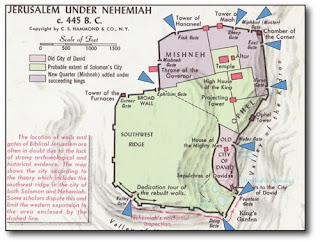
In the Hebrew language, one word for hell is “Gehenna.” Lying to the
south of Jerusalem, Gehenna was the place where child sacrifices were
offered. We are told of King Ahaz in 2 Kings 16:3, “But he walked in the
way of the kings of Israel, yea, and made his son to pass through the
fire, according to the abominations of the heathen, whom the LORD cast
out from before the children of Israel.” Manasseh also followed this
abominable practice, “And he made his son pass through the fire, and
observed times, and used enchantments, and dealt with familiar spirits
and wizards: he wrought much wickedness in the sight of the LORD, to
provoke him to anger” (2 Ki. 21:6).
Gehenna is the name of the valley of the sons of Hinnom. Jeremiah 7:31-32 says, “And they have built the high places of Tophet, which is in the valley of the son of Hinnom, to burn their sons and their daughters in the fire; which I commanded them not, neither came it into my heart. Therefore, behold, the days come, saith the LORD, that it shall no more be called Tophet, nor the valley of the son of
Hinnom, but the valley of slaughter: for they shall bury in Tophet, till there be no place.”
Thus we can see that Gehenna will be the place of God’s judgment. The Jewish apocalyptics assume that after the final judgment, Gehenna will become the lake of fire. This is justified, especially by Isaiah 66:23-24, which speaks of the open pit during the millennial reign of Christ upon earth, “And it shall come to pass, that from one new moon to another, and from one sabbath to another, shall all flesh come to worship before me, saith the LORD. And they shall go forth, and look upon
the carcases of the men that have transgressed against me: for their worm shall not die, neither shall their fire be quenched; and they shall be an abhorring unto all flesh.”
The geographical Gehenna seems to be one of the places where the tormented may be viewed during the millennial reign. The words “They shall go forth…” suggest that this place is
in close proximity to the temple area in Jerusalem, which was the case for the geographical Gehenna. Thus in the New Testament, Gehenna became the generic name for hell. It is used 12 times in the Greek New Testament.
In Matthew 25:41, the Lord makes it clear that Gehenna was a pre-existent entity, “Then shall he say also unto them on the left hand, Depart from me, ye cursed, into everlasting fire, prepared for the devil and his angels.”
It is a fiery abyss, a place of everlasting fire that shall never be quenched. It is also the place of the punishment of eternal damnation after the Last Judgment. Mark 9:43-44 reads, “And if thy hand offend thee, cut it off: it is better for thee to enter into life maimed, than having two hands to go into hell [in Greek “Geena” or Gehenna”], into the fire that never shall be quenched: Where their worm dieth not, and the fire is not quenched.”
Hades
Another word for hell is “Hades,” which means the land of darkness. Hades receives the unsaved dead prior to the final judgment, as we see in Revelation 20:13-14, “And the sea gave up the dead which were in it; and death and hell [Hades] delivered up the dead which were in them: and they were judged every man according to their works. And death and hell were cast into the lake of fire. This is the second death.” Then they pass into the lake of fire, which burns eternally.
Hades is used in the New Testament in Matthew 11:23, “And thou, Capernaum, which art exalted unto heaven, shalt be brought down to hell [Hades]: for if the mighty works, which have been done in thee, had been done in Sodom, it would have remained until this day.”
Matthew 16:18 also uses Hades, “And I say also unto thee, That thou art Peter, and upon this rock I will build my church; and the gates of hell [Hades] shall not prevail against it.” Here, the sense is that the powers of Satan located in Hades cannot overcome the Church.
Abyss
Another term for hell is the “abyss.” We read in Revelation 9:11, “And they had a king over them, which is the angel of the bottomless pit [abyss], whose name in the Hebrew tongue is Abaddon, but in the Greek tongue hath his name Apollyon.” The abyss is described as a bottomless pit filled with smoke, brimstone, and the torment of the ungodly. It is also populated by all sorts of evil spirits (Rev. 9:1-10).


Comments
Post a Comment